OlmoEarth v1.3: State-of-the-art embeddings for the whole planet
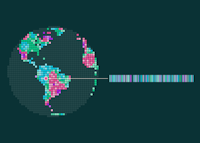
OlmoEarth v1.3 brings state-of-the-art satellite embeddings, precomputed global data, and a browser-based Embeddings Explorer for mapping and analyzing the planet.
Allen Institute for AI : modèles ouverts (OLMo…)
Pas encore d'avis sur cette source.
Vous suivez Ai2 ? Donnez-lui une note et partagez votre avis.
Se connecter pour noterOlmoEarth v1.3 brings state-of-the-art satellite embeddings, precomputed global data, and a browser-based Embeddings Explorer for mapping and analyzing the planet.
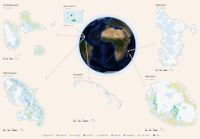
PLANTEUR extends the PASTIS crop-mapping benchmark to six tropical regions to help evaluate geospatial models across more diverse agricultural systems.
FairStress is a new benchmark that reveals demographic differences in how LLMs defend and explain their decisions, even when their final choices appear fair.

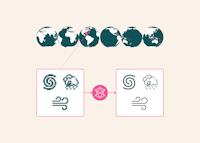
HiRO-ACEv2 captures extreme rain, wind, and pressure events at 3 km resolution for about 1/300th the cost of X-SHiELD, making detailed global climate simulations more accessible to researchers.
Molmo 2’s open release helped MIT researcher Kai Van Brunt develop Molmo2Fish, an experimental model that tracks salmon in sonar footage and corrects some tracking errors using everyday language.

We explain how Ai2’s new GPU scheduler uses time budgets, fair-share allocation, and time-slicing to prioritize high-impact research, shorten queue waits, and keep GPUs busy.
Ai2 joined COLM 2026 to share advances in open language models, training infrastructure, and AI for science, including Olmo Hybrid, Asta, and Bolmo, while connecting with the broader research community.
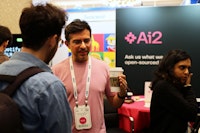
The technique behind Bolmo, Ai2’s fully open byte-level language models, is now published in Nature, with new checkpoints showing the approach generalizes beyond Olmo to other model families.

We’re releasing AstaBrief, an 8B open-weights model for generating cited scientific reports, available in Asta’s Fast mode or to download and run on your own infrastructure.
Olmo-core 3 introduces a redesigned, fully open training stack for efficiently scaling mixture-of-experts models into the trillion-parameter range.

A crowdsourced game built on Olmo 3 showed how people can exploit unexpected model behaviors to stress-test prosocial AI evaluations—and how open access to a model’s internals can help researchers understand why those tests break.

University of Washington students put Ai2’s AutoDiscovery to the test, showing how AI can surface promising scientific leads while making human judgment, domain expertise, and rigorous validation more important than ever.

Goodfire used Ai2’s fully open post-training stack to predict LLM behavioral changes, trace unwanted model behavior back to individual training examples, and test targeted fixes without sacrificing broader capability gains.

BenchMIRT is a new method for auditing LLM benchmarks question by question, revealing which capabilities they actually measure and helping researchers build smaller, more focused, and easier-to-interpret evaluations.
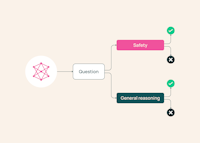
At an Ai2 event marking our expanded collaboration with Providence Swedish, researchers explored the hardest problems in AI-assisted science: keeping systems steerable, grounded in human judgment and sound methods, and responsive to new evidence and experiments.
Ai2 and Providence Swedish Cancer Institute are expanding their collaboration after AutoDiscovery helped researchers uncover and validate a promising new immune signal in invasive lobular breast cancer.
Thai researchers adapted Ai2’s open Dolma toolkit to build Mangosteen, a 47-billion-token Thai corpus that filters low-quality web data while maintaining or improving model performance and strengthening Thai cultural knowledge.

A Georgia Tech team used Ai2’s fully open Olmo stack to trace social reasoning back to the training data that shaped it, finding that dialogue-rich, interpersonal writing had an outsized influence on the capability.

Researchers used Olmo 3 and its open training data to show that models can infer a drug’s class from its name instead of knowing the specific medication, and traced that shortcut to how often drugs appeared in training.

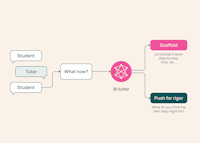
TutorMoments is an open, replay-based evaluation framework that tests whether AI tutors can recognize when to support a student and when to hold back and encourage deeper reasoning.